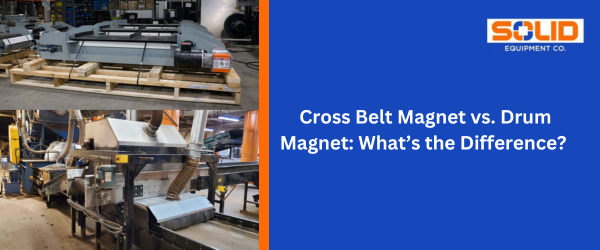
In scrap yards, MRFs, and industrial recycling facilities, choosing the right magnetic separation equipment directly affects recovery purity, uptime, and ROI. If you’re deciding between a cross belt magnet and a drum magnet, the real question isn’t which is better; it’s which fits your material flow and recovery goals.
Both are essential pieces of industrial magnetic separation equipment, but they function differently within ferrous metal recovery systems.
How a Cross Belt Magnet Works
A cross belt magnet (also called anoverband magnet) is suspended above a conveyor belt. As material passes underneath, the magnet pulls ferrous metals upward and away from the material stream. A self-cleaning belt then carries the captured metal to the side and discharges it.
Best Applications
A cross belt magnet performs well in:
- Shredded automobiles
- Auto shred residue
- MSW
- Construction debris
- E-scrap and electronic scrap
- High-volume scrap metal processing
Because it sits above the conveyor, it works well as a continuous, self-cleaning separator in high-throughput systems.
Key Performance Characteristics
- Continuous operation
- Handles variable feed sizes
- Ideal for primary separation
- Moderate footprint (over conveyor)
- Requires structural mounting and power for belt drive
For many facilities, a cross belt magnet for sale is the first line of defense to remove ferrous metals before downstream processing.
How a Drum Magnet Works Best Applications
Drum separator magnets are excellent for:
- Clean shredded scrap
- Wire recovery lines
- E-scrap refinement
- Secondary or staged separation
- Applications requiring higher purity
Because material directly contacts the drum, separation can be more precise.
Key Performance Characteristics
- Compact installation footprint
- Lower profile than overhead systems
- Strong control of discharge
- Ideal for staged or finishing separation
- Less structural overhead support required
If your goal is higher recovery purity in refined streams, a drum magnet for sale often makes sense.
Side-by-Side Comparison
| Feature | Cross Belt Magnet | Drum Magnet |
| Position in Flow | Suspended over conveyor | Inline, at discharge or chute |
| Cleaning | Self-cleaning belt | Self-cleaning via rotation |
| Throughput | High-volume primary separation | Controlled, refined separation |
| Installation | Requires overhead mounting | Compact, integrated |
| Ideal Material | Shredded automobiles, C&D, MSW | Clean scrap, wire, e-scrap |
| Separation Stage | Primary removal | Secondary or finishing stage |
How to Choose the Best Magnet for Scrap Metal Separation
1. Material Type
- Heavy shredded automobiles or C&D debris? Cross belt magnet
- Clean wire, electronic scrap, or refined e-scrap? Drum magnet
- Mixed MSW or unpredictable feedstock? Cross belt magnet
2. Desired Recovery Purity
- Higher initial volume capture → Cross belt magnet
- Higher final purity → Drum separator magnets
3. Continuous vs. Staged Separation
- Need continuous, hands-off removal? Cross belt magnet
- Need controlled, staged refinement? Drum magnet
4. Space & Conveyor Layout
- Limited overhead clearance? Drum separator magnets for sale may fit better
- Long conveyor lines with room above? Cross belt systems integrate easily
A Trusted Supplier for Equipment Sourcing and ROI
Whether you are investing in new systems or exploring used recycling equipment for sale, partnering with a t rusted industrial equipment supplier matters.
Solid Equipmentsupports facilities wi th:
- Cross belt magnet for sale options
- Drum separator magnets for sale
- Scrap handling magnet systems
- Used recycling equipment
- Financing solutions
- In-house support and parts availability
Final Takeaway
The difference between a cross belt magnet and a drum magnet comes down to position, performance role, and recovery goals. A cross belt magnet excels at high-volume, continuous primary separation. A drum magnet refines material for higher purity output.
For most operations focused on uptime, purity, and ROI, the best solution is often both — working together to maximize metal recovery while keeping your metal recycling machine running efficiently.