All posts by admin

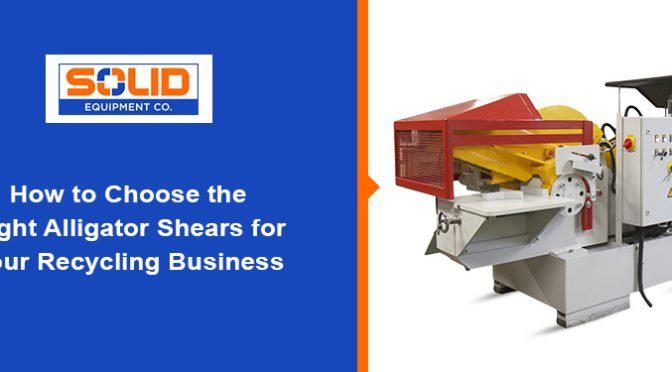
How to Choose the Right Alligator Shears for Your Recycling Business

When it comes to recycling, alligator shears are a must-have tool for your recycling business or any scrap metal processing facility. These powerful tools are designed to easily cut through various types of scrap metal, and they’re essential for breaking down large pieces of metal into smaller, more manageable pieces.

With so many different shears on the market, knowing which one is right for your business can be challenging. E.g., alligator shears and catalytic converter shears are two different types of cutting tools used in the recycling industry. While they may appear similar at first glance, the two have some key differences.

Alligator shears are hydraulic cutting tools used to cut and process various types of scrap metal. On the other hand, catalytic converter shears are a specialized cutting tool used specifically for processing catalytic converters.

Catalytic converters are devices found in the exhaust systems of vehicles that convert harmful pollutants into less harmful emissions.

Catalytic converter shears are usually smaller and more compact, designed to be used in tight spaces. These shears are designed to cut through the metal shell of the catalytic converter to access the valuable metals inside, such as platinum, palladium, and rhodium.

In this blog, we’ll discuss how to choose the right shears for your recycling business, including factors like size, cutting force, and more.

Determine Why You Need Alligator Shears

Before you can start shopping for alligator shears, it’s essential to determine your cutting needs. What types of scrap metal will you be processing? How thick are the materials you’ll be cutting? How frequently will you need to use your them? These are all critical questions when selecting the right tool for your recycling business.

Be sure to consider your cutting needs carefully before making a final decision. If you are cutting thick, heavy-duty materials like steel and aluminum, you’ll need a more powerful alligator shear with a higher cutting force. On the other hand, if you are processing lighter materials like copper wire, an electric wire stripper or copper wire stripper may be a better option.

How to Choose the Right Size Alligator Shear

Alligator shears come in various sizes, from small handheld tools to massive industrial machines. The size you choose will depend on the amount of scrap metal you’ll be processing and the space available in your facility.

A handheld alligator shear may be sufficient for working with smaller scrap metal. These tools are lightweight and portable, making them ideal for cutting small pieces of metal. However, if you’re processing larger amounts of scrap metal, you’ll need a larger alligator shear with a higher cutting capacity.

Consider the Cutting Force

It’s essential to choose an alligator shear with a cutting force that’s appropriate for the types of materials you’ll be cutting. The cutting force is the pressure an alligator shear can exert on a piece of metal. Some alligator shears have a cutting force of just a few tons, while others can exert pressure over 100 tons.

Remember that a higher cutting force doesn’t necessarily mean a better tool. If you are processing lighter materials, a lower cutting force may be more than sufficient. On the other hand, if you are working with thicker, heavier materials, you’ll need an alligator shear with a higher cutting force.

What Additional Features Does the Alligator Shear Have?

In addition to cutting force, there are several other features to consider when selecting an alligator shear for your recycling business. Some additional features to look for include:

Automatic or manual operation: Alligator shears can be either automatic or manual. Automatic ones are more efficient and require less effort to operate, while manual shears require more physical labor but are generally more affordable.

Blade size and shape: The size and shape of the blade will impact the type of materials you can cut with your alligator shear. Be sure to select a blade appropriate for the materials you’ll be working with.

Safety features: Alligator shears can be dangerous tools if not used properly. Look for models with safety features like blade guards and emergency shut-off switches to minimize the risk of injury.

Finally, choosing a reliable supplier is crucial when selecting an alligator shear for your recycling business. Look for a company with a proven track record of providing top-quality recycling equipment to ensure you get the best possible product.

Alligator Shears Supplier

Solid Equipment Company is an excellent choice for choosing a reliable brand for alligator shears and other recycling equipment needs in the United States. With their extensive selection of high-quality products from the industry’s top brands, they can help you choose the right products for your needs and take your recycling business to the next level. Contact us today!
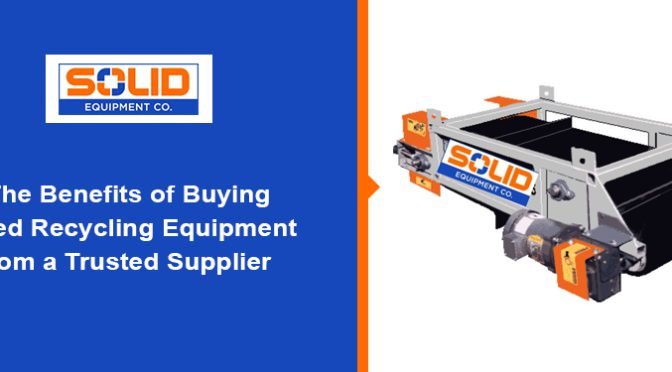
The Benefits of Buying Used Recycling Equipment from a Trusted Supplier

Industrial Recycling Equipment

Industrial recycling not only helps preserve natural resources but also reduces waste and greenhouse gas emissions. In recent years, the importance of recycling has gained a lot of attention, and businesses are doing their best to make their operations eco-friendly. However, implementing industrial recycling initiatives can be expensive, so many companies are using equipment to save costs. In this Blog, we’ll explore the benefits of buying used industrial recycling equipment from a trusted supplier.

Cost Savings

The primary benefit of buying used recycling equipment is cost savings. Industrial recycling can be expensive, especially for small businesses starting recycling operations.

Used recycling equipment is a cost-effective solution that allows companies to acquire the necessary machinery at a fraction of the cost of buying new equipment. The savings can be significant, freeing up funds to invest in other business areas.

Quality Equipment

Buying used equipment from a trusted supplier will ensure the machinery is of high quality. When you purchase from a reputable supplier, you can trust that the equipment has been properly maintained, serviced, and tested.

Environmentally Friendly

Buying used equipment is an eco-friendly solution because it helps to reduce waste. By purchasing pre-owned machinery, businesses are essentially recycling the equipment, giving it a new life, and reducing the resources required to produce new machinery.

The equipment is tested and maintained to be energy-efficient, which helps businesses reduce their carbon footprint.

Used Recycling Equipment Supplier

At Solid Equipment Company, we are proud to offer a range of high-quality used equipment to businesses across the United States. Our team of experts has the know-how and experience to help you find the right machinery for your business.

By purchasing repurposed equipment from a trusted supplier like Solid Equipment, you can be sure to get the equipment you need for your business-specific needs.

Contact us today to learn more about our inventory and how we can help you take your recycling operations to the next level.

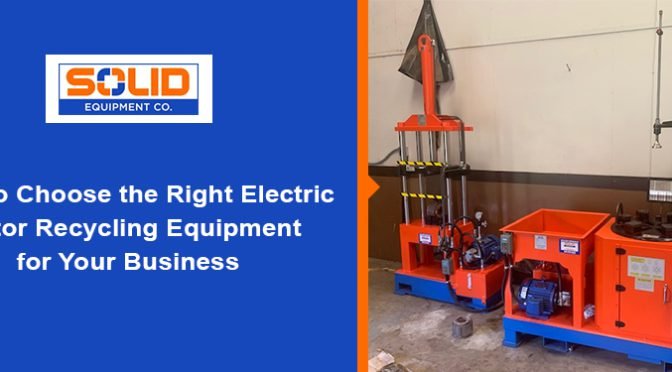
How to Choose the Right Electric Motor Recycling Equipment for Your Business

Electric motor recycling equipment are crucial components of many industrial and commercial applications. They power everything from fans and pumps to conveyor belts and manufacturing equipment. However, electric motors don’t last forever, and when they reach the end of their useful life, they need to be disposed of properly.

Electric motor recycling equipment is essential for businesses that want to extract the valuable metals inside these motors and minimize waste. In this blog, we’ll explore how to choose the right electric motor recycling machine for your business.

Consider the Types of Electric Motors You’re Recycling

Before you start shopping for electric motor recycling equipment, it’s essential to consider the types of motors you’ll be recycling. There are two primary types of electric motors: AC and DC motors. AC motors are the most common type used in everything from household appliances to industrial equipment. DC motors are less common but are still used in some applications, such as electric cars.

AC motors can be further categorized into three types: induction motors, synchronous motors, and servo motors.

  • Induction motors are the most common type used in applications requiring constant speed, such as fans and pumps.
  • Synchronous motors are used in applications that require precise speed control, such as printing presses and industrial machines.
  • Servo motors are used in applications that require high accuracy and precision, such as robotics and CNC machines.

Different types of electric motors require different recycling equipment, so choosing equipment that can handle the motors you’ll be recycling is crucial. Make sure to research which types of motors are most commonly used in your industry and choose equipment accordingly.

Consider Your Production Volume

Another important factor to consider when choosing electric motor recycling equipment is your production volume. If you’re a small business that only recycles a few motors a month, you may get by with a smaller, less expensive, or used electric motor recycling machine. However, if you’re a large industrial operation that recycles hundreds or thousands of motors monthly, you’ll need a more powerful and efficient machine.

When considering your production volume, it’s important to think about not just the number of motors you’ll be recycling but also their size and weight. Larger motors will require more powerful equipment, and heavier motors will require equipment with a higher weight capacity.

Consider Your Budget

Electric motor equipment can range from a few thousand dollars to tens of thousands of dollars, depending on the size and complexity of the machine. It’s essential to consider your budget when choosing equipment and to balance your needs with your financial limitations.

When considering your budget, it’s important to look beyond the initial purchase price and consider the long-term costs of owning and operating the equipment. Maintenance, repairs, and energy costs can add up over time and should be factored into your budget.

Consider the Features You Need

When choosing electric motor recycling equipment, it’s important to consider the features you need. Different machines have different features, such as automatic feeding, dust collection, and magnetic separation.

List the most important features and prioritize them when choosing equipment.

In addition to these features, consider the level of automation of the equipment. Fully automated machines can streamline the recycling process and reduce the need for manual labor, but they also come with a higher price tag.

Electric motor recycling equipment is an essential investment for businesses that want to minimize waste and extract valuable materials from end-of-life motors.

Electric Recycling Equipment Supplier

At Solid Equipment Company, we are an industrial recycling equipment business that offers an extensive selection of products from the industry’s top brands.

We evaluate our client’s unique needs and purposes and make machine recommendations to serve their project needs and budget. Our services are available across the United States in New York, Maryland, Illinois, Pennsylvania, North Carolina, Georgia, South Carolina, Michigan, Indiana, and Texas. Contact today!

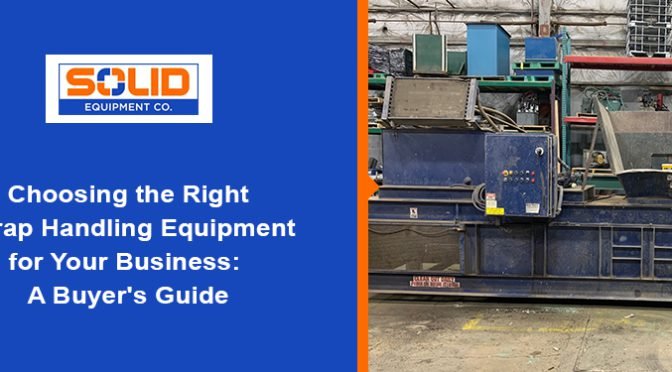
Choosing the Right Scrap Handling Equipment for Your Business: A Buyer’s Guide

In today’s fast-paced industrial world, scrap handling has become an essential part of many businesses. Efficiently handling scrap materials can help companies reduce costs, increase productivity, and generate additional revenue. However, choosing the right scrap-handling equipment for your business can be daunting. With so many options around, knowing where to start can be challenging. In this blog, we will discuss key factors to consider when selecting scrap-handling equipment for your business.

Understand Your Scrap Handling Needs

The first step in choosing the right equipment is understanding your scrap handling needs. Start by asking yourself the following questions:

What type of scrap does my business handle?

How much scrap can it handle?

What is the size and weight of the scrap?

How often does it need to handle scrap?

What is the level of automation required?

What are the budget constraints?

By pondering these questions, you will get a clearer picture of your requirements and can make a more informed decision.

Types of Scrap Handling Equipment

There are several types of scrap handling equipment available in the market. They can be divided into different categories like industrial recycling equipment, demolition equipment, vehicle recycling equipment and more.

Hydraulic shears, alligator shear, wire granulators, hammer mills, electric motor recycling, etc., are among the much-needed scrap handling equipment for industrial use.

For demolition needs, there is a different array of equipment like demolition arms, dust suppression equipment, skeleton bucket, hydraulic breakers, and more.

Wheel rim popper, auto shear, fuel extraction, and mobile vehicle dismantling container top the list for vehicle recycling equipment.

Factors to Consider

Once you have identified the type of equipment that suits your needs, there are several factors to consider before making a final decision.

Size and Capacity

The size and capacity of the equipment should match your requirements. Consider the volume of scrap you handle, the space available for the equipment, and the throughput required.

Power and Performance 

The power and performance of the equipment should be adequate for the type of scrap you handle. Consider factors such as motor horsepower, cutting force, and cycle time.

Safety 

Safety is a crucial factor when handling scrap. Ensure that the equipment you choose is designed with safety features like emergency stop buttons, safety guards, and lockout systems.

Maintenance and Service 

Proper maintenance and service are essential for the longevity and reliability of the equipment. Consider factors such as ease of maintenance, availability of spare parts, and service support.

Cost

Cost is an important factor when choosing equipment. Consider the initial purchase price, operating costs, and return on investment.

You can make an informed decision by understanding your scrap handling needs, considering the different types of equipment available, and evaluating factors such as size and capacity, power and performance, safety, maintenance and service, and cost.

An industrial recycling equipment business, Solid Equipment Company offers an extensive selection of products from the industry’s top brands, including Bronneberg, Holmatro, and Buffalo Turbine. We are a leading supplier of scrap handling equipment in the United States and can help you choose the right equipment for your business. Contact us today to learn more.

Understanding the Basics of Recycling Electric Vehicle Batteries

The future is now. Electric vehicles are no longer a sci-fi fantasy or something only accessible to individuals with deep pockets. Responding to the global push to reduce carbon emissions, more major auto manufacturers are coming out with affordable, everyday models bringing electric cars to middle-class consumers. As the demand surge begins, experts are already warning of a key sustainability risk that could be realized as soon as 2030.

The essence of EVs is the battery. It’s what makes electric vehicles, well, electric. Designed to last years and thousands of miles of use, EV batteries contain precious, non-renewable minerals deep within their thousands of cells. Scientists and manufacturers now need to figure out how to recycle electric vehicle batteries before we encounter a global mining crisis and (more) overloaded landfills.

But research efforts are underway! And this is one saga we at Solid Equipment Company will follow closely. For now, we’ll share what we know so far. We’ll start with a brief review of how batteries work, then get into the fascinating details of recycling electric vehicle batteries.

How Does a Battery Work?

A battery converts chemical energy into electrical energy. Thus, all batteries have some sort of liquid chemical inside of them.

The main components of a battery are:

  • Chemical base
  • Electrodes
  • Electrolyte solution

Nickel, cadmium, lead, acid, and lithium are the most common battery chemical bases. Electricity is generated when the chemical base flows between two electrodes (the “plus” and “minus” ends of a battery) via a conductive chemical called an electrolyte solution. The grouping of these basic components is called a cell. Lastly, all batteries have some sort of casing around them to protect the cells and hold them in place.

What Makes Electric Vehicle Batteries Different?

The main components of an EV battery are the same as other batteries, but the size and amounts of those components are vastly different (aka larger).

A standard car battery is a 12-volt battery with six cells. EV batteries have thousands of cells. A standard car battery weighs between 30 to 50 pounds. An EV battery weighs 1,000 pounds or more.

The other foundational difference is the chemical base. Standard car batteries have a lead-acid base, while EV batteries use the now infamous (thanks to cell phones) lithium-ion base.

Imminent Importance of Recycling Electric Vehicle Batteries

Lithium-ion batteries are the choice battery for electric cars and other high-use electronics because they can store a lot of electricity in a small amount of space (high energy density). Lithium, cobalt, copper, and nickel are raw materials found in lithium-ion batteries.

Raw materials such as these come from the Earth and must be mined. But mining alone will not support mass EV battery production.

The amount of these minerals on the Earth is finite, therefore, industries must figure out how to recycle EV batteries and extract the minerals for reuse.

Better recycling methods are also needed to make sure the exceptionally large EV batteries don’t end up in landfills (spoiler alert: There isn’t enough space).

How Electric Vehicle Battery Recycling Works

Only three methods exist currently. Each is very primitive but nonetheless presents useful pros and cons scientists can learn from. These methods are pyrometallurgy, hydrometallurgy, and direct recycling. While some are better than others in various areas, the collective benefits do not come close to addressing the issue on a large scale.

The most pressing need is an eco-responsible process for extracting the valuable (and non-renewable) raw materials from the chemical cells. Recycling industries have much to perfect with the extraction process. Current methods are not energy smart or eco-friendly — yet.

Many organizations throughout the world are facing the challenge head-on, including the Faraday Institution’s Reuse and Recycling of Lithium-Ion Batteries (ReLib) project at the University of Birmingham in the United Kingdom.

Equipment for EV Recycling.

While there is much to discover around EV battery recycling, Solid Equipment Company has many products that can support the possibilities at a large scale, and we’re excited to contribute to the global cause.

The jury is still out on extracting raw materials from the chemicals, but stainless steel separation conveyors and wire granulators can extract the precious copper and aluminum from electrical wires. EV batteries have a fair amount of wiring to them as well, and our equipment is at the ready.

Given their built-to-last construction, cracking into EV batteries will likely require hydraulic equipment, while attachments for heavy-duty lifting offer safety and efficiency to any industrial operation. The GYRB-brand attachments we sell are adaptable to all types of machinery already on the market, perhaps creating opportunities for easy implementation when the time comes for large-scale EV battery recycling. Recyclers will need something to lift those 1,000-pound batteries!

About Solid Equipment Company

Solid Equipment Company is an industrial recycling equipment distributor that offers an extensive selection of new and used equipment from top manufacturers, designed to recover full value from the entire range of metal and scrap products. We distribute all throughout the United States and Canada.

If you’re in the metal recycling business and looking to improve your profitability, call 855-952-2226 today and get started on a consultation with one of our experts.

Alligator Shears for Recycling & Scrap Processing

When your recycling facility or scrapyard needs to cut metals into smaller sizes for sorting and baling or shredding, alligator shears are a great for efficient recycling & scrap processing. They offer powerful blades that can quickly cut through things like rebar, car radiators, and thick copper cables. The stationary design makes this tool safer to use than portable hydraulic shears while adding additional power to cut through tougher materials.

How Do Alligator Shears Work?

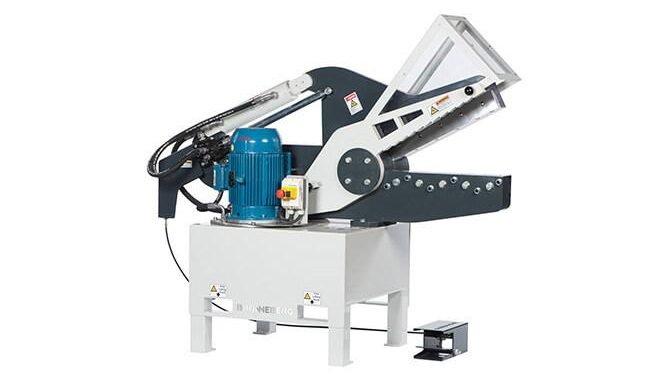
Alligator shears use a fixed jaw on the bottom and a hinged jaw on the top with hardened steel blades to cut through materials. The top jaw pivots downward to cut, similar to scissors. A hydraulic pump and cylinder drive the upper jaw, with guards that pivot along with the jaw to protect the operator from injuries. Together, the two jaws look similar to an alligator’s mouth, hence the name. Other common names for the shears include crocodile shears or lever shears. The jaws can vary in size from 4 inches to over 36 inches, though typical models range from 16 to 24 inches.

What Are Alligator Shears Used For?

Most often, they are used to cut scrap metal into manageable sizes for recycling at industrial recycling facilities, scrapyards, or demolition sites. But they can also be useful for cutting steel or aluminum stock to size as long as a precision cut is not required, such as when you’re cutting rebar to length, angle iron, pipes, or ground stakes. Unlike portable hydraulic shears, the material must be brought to the machine for cutting, so material sizes are limited to what can easily be carried. Alligator shears are often used to cut:

  • Car radiators
  • Car exhausts
  • Copper cables or wire
  • Aluminum extrusions
  • Rebar
  • Copper, aluminum, or steel pipes
  • Angle iron
  • Small sheet metal parts or assemblies

More powerful models can be used at steel suppliers or construction sites to cut I-beams, C-channel, or steel tubing to length.

Benefits of Alligator Shears

Alligator shears are a great tool for any facility that needs to cut large volumes of metal in a safe and controlled manner. Some of their primary benefits include:

  • Hardened steel jaws to cut through tough materials
  • Powerful hydraulic cylinders to drive the jaws
  • Clean cuts with no chips and minimal waste
  • Stationary design with guards for worker safety
  • Multiple sizes for varying materials

Alligator Shears & Hydraulic Shears for Your Recycling Facility

If you are considering alligator shears or hydraulic shears for your recycling facility or scrapyard, turn to our experts at Solid Equipment Company. We feature collection with up to 250 tons of force and 16-, 20-, or 24-inch blade lengths. We also feature portable hydraulic shears for the disassembly of larger objects like car bodies, frames, or buildings, as well as battery-operated shears for the ultimate in portability.

Our company offers both new  and high-quality used alligator or hydraulic shears at competitive prices. Boost your business’s already efficient recycling & scrap processing, making it more productive and profitable. We serve industrial recycling facilities, scrapyards, vehicle recyclers, and demolition companies throughout the United States. With our extensive knowledge, we can help with all your recycling equipment needs, and we offer great service and support with all our equipment.

Give us a call today at 866-948-5406 or contact us online to request a quote for alligator shears or hydraulic shears, and be sure to stop by our used equipment page for quality equipment at significant savings.

Why Buy Used Recycling Equipment?

Recycling equipment like Wheel Poppers, Electric Motor Recycling Machines , or Wire Granulators can be a significant investment if you are buying new equipment, but there are often used options available that can be a great value. Why should you consider buying used equipment for your recycling facility? Here are a few reasons that may make sense for your needs:

Equipment Cost

Used recycling equipment will obviously cost less than new equipment. New machines can depreciate quickly due to their use in harsh environments, so the purchase price of used equipment is often far more affordable.

Equipment Upgrades

It can be a great way to upgrade to a better model at a lower cost. If you need to upgrade to a scrap handling magnet or a grapple, for example, or you need a shredder that can handle larger amounts of material, buying used can allow you to upgrade without paying a premium for new equipment. Plus, if you are buying equipment that was replaced simply because it no longer meets the capacity or feature needs of the original owner, that equipment may be in good overall condition for the price.

Exploring New Markets

If you would like to explore more recycling options for your business, buying new may not make financial sense until you know there is a profitable market available for the material you would like to process. For example, a used electric motor recycler or wire stripping machine can be a good option if you would like to expand into copper recycling without a large upfront investment. Once the market is proven and you are making a profit, you can consider upgrading or buying new equipment.

Expanding Your Business

As your business grows, you may need to add more workers to keep up with demand. It may not always be possible, or even advisable, to equip new workers with the best equipment possible. Used equipment gives you the opportunity to expand your business faster with a smaller investment. And in the case of new workers, equipping them with a set of used hydraulic shears, for example, instead of new ones, reduces the loss should they dull the blades or break a hydraulic hose.

Used Recycling Equipment at Cost-Effective Prices

When you are interested in quality used recycling equipment for your scrapyard or recycling facility, turn to our team at Solid Equipment Company. As a nationwide dealer of scrap recycling equipment, vehicle recycling equipment, demolition equipment, and more, we have a wide range of both new and used equipment available at all times. Our company features top-quality products, competitive prices, and impressive value.

Give us a call at 866-948-5406 request a quote for recycling equipment. You can also view our used equipment inventory online.

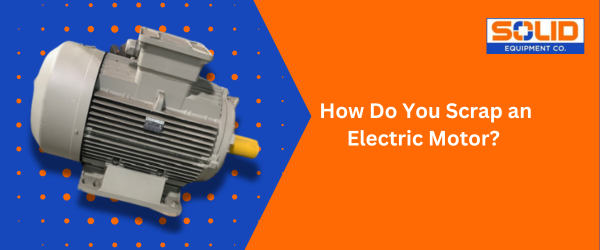
How Do You Scrap an Electric Motor?

Electric motors are found everywhere, from heavy equipment and household appliances to industrial facilities and electric vehicles. They contain significant amounts of materials like copper, brass, aluminum, and steel that have some scrap value, though harvesting these materials in an efficient and cost-effective manner can be a challenge. The basic steps for recycling an electric motor include:

  • Disassembly: All the fasteners that secure brackets and endplates to the housing are removed, and the motor is stripped of all external components like capacitors, bearings, pulleys, or controls.
  • Splitting the case: To access the rotor, stator, commutator, and windings, the case must be opened. This can be done with hammers and chisels, hydraulic shears, or a hammer mill.
  • Separating the components: The copper windings need to be separated from the ferrous core. Cutting or splitting the iron or laminated steel core is often the easiest way to access the copper windings.
  • Sorting the materials: Any tape and insulation layers, cording, and plastics need to be removed, then the materials can be stripped and sorted according to metal type for scrap recycling.


At Solid Equipment Company, our electric motor recycling machines make quick work of scrapping electric motors. They feature specialized hydraulic shears to split cases, steel stator or transformer cores, and a semi-automatic copper extraction system that uses clamps and presses to extract the copper windings. Our systems make recycling electric motors less labor-intensive, faster, and more cost-efficient.

Electric Car Recycling

Electric vehicles have far more in scrap value than just the materials in the electric motors. Steel and aluminum from the body and frame can be recycled, as well as the batteries powering the car.

To recycle an electric vehicle, it is important to disconnect and remove the battery packs safely. They have extremely high and dangerous DC voltages, leading to potential electrocution and fire hazards. Once the battery is safe, the aluminum and steel components can be salvaged, while plastics, fabric, and other materials can be discarded or redirected to other recycling channels.

Batteries that have some useful service life remaining can be transferred to secondary markets like solar battery storage systems, while batteries that have no service potential can be discharged and stripped down to salvage valuable metals such as aluminum, steel, cobalt, and lithium. Recycling batteries takes special training and equipment to complete safely, so this is usually done by third parties that specialize in the service.

To learn more about the recycling processes for electric motors and electric vehicles, as well as the equipment that can make these tasks easier, browse our industrial recycling equipment guide or talk to our experts at Solid Equipment Company. Call us at 866-948-5406 or contact us online.

Electric Motor & Vehicle Recycling Equipment for Your Scrap Facility

Are you interested in equipment that makes it easier and more cost-effective to scrap electric motors and vehicles? Contact our team at Solid Equipment Company. We offer reliable, high-quality electric motor recycling machines, hydraulic shears, hammer mills, vehicle recycling equipment, scrap metal balers, high-volume wire strippers, and more. We serve scrapyards, recycling centers, demolition companies, and construction firms throughout the United States, and we offer both new and used equipment at great prices. With unsurpassed service and support, a knowledgeable team, and quality products, we are here to help with all your scrap and recycling needs.

Call 866-948-5406 or contact us online to learn more about our electric motor recycling equipment or to request a quote.

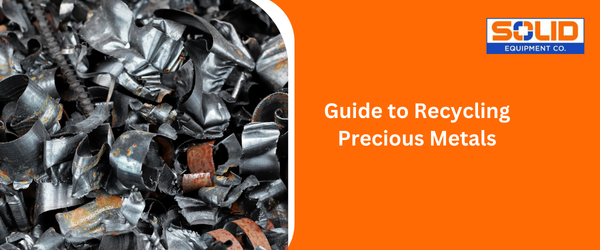
Guide to Recycling Precious Metals

Every year, an unimaginable amount of precious metal goes to waste in landfills. People often don’t know they can recycle jewelry or electronics containing these metals, with few refineries equipped for the task. Solid Equipment Company aims to change this by offering equipment to separate precious metals from scrap. This helps the environment and allows our customers to profit and thrive.

What Are Precious Metals?

A precious metal is a natural metallic chemical element that has a low supply and a high value. They are generally more flexible and less reactive than more commonly available metals. The primary four precious metals are:

  • Silver
  • Gold
  • Platinum
  • Palladium

These metals can be found in some astonishing places. In addition to being found in coins, jewelry, and electronics, precious metals appear in X-ray film, catalytic converters, and electrophysiology catheters.

How Are Precious Metals Recycled?

The first step is to collect all the materials you believe contain precious metals. When you’re working primarily with jewelry, the process is simple. If you are working with large batches of scrap, it’s crucial to sort out the metals visually or use tools like high-powered magnets. It can be helpful to compress the recovered metals with something like a scrap metal baler to make the next step easier.

The metals should then be shredded using equipment like hydraulic shears. Shredded metals melt faster and more evenly, which results in less energy waste through the process.

After being melted, the metal must be purified and checked for homogeneity. Once the batch is confirmed to be thoroughly mixed and contaminant-free, the melted metal solidifies into a bar-shaped mold after being poured. The bar shape makes it easier to sell to a variety of different merchants.

The Impact of Recycling Precious Metals

Collecting, sorting, and fully recycling precious metals may seem challenging, but the payoff is tangible from two perspectives. The United Nations estimates that about $10 billion worth of precious metals in electronic waste is dumped in landfills each year. This growing mountain of electronic waste causes severe pollution issues, which can be mitigated with more robust recycling efforts.

This untapped market for wasted metals offers a profitable opportunity for industrious individuals or organizations, while also helping to combat climate change.

Solid Equipment Company is here to help by providing the specialty equipment you need to recycle precious metals effectively. Call us at 866-948-5406 for more information on how we can fulfill your needs.

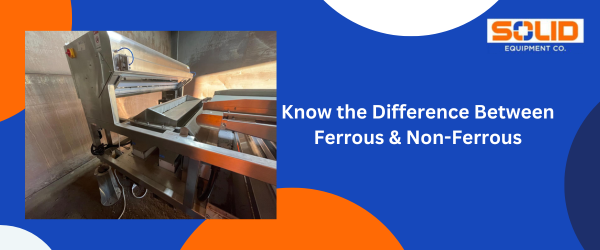
Know the Difference Between Ferrous & Non-ferrous

Scrap metal recycling is a lucrative, environmentally friendly business. Before you can get started, it’s imperative to understand the difference between ferrous & non-ferrous metals. In short, ferrous metals contain iron, while non-ferrous metals do not. This defining characteristic determines which uses and applications these metals are best suited for and how they are recycled.

What is Ferrous Metal?

Ferrous metals are alloys, meaning they contain several different metals, including iron. This makes ferrous metals strong, durable, and magnetic. Unfortunately, the high iron content also makes ferrous metals prone to rusting in wet environments.

Examples of these metals include steel, carbon steel, alloy steel, cast iron, and wrought iron. These materials are used in the following applications:

  • Engines and car parts
  • Building materials
  • Industrial piping
  • Machinery
  • Shipping containers
  • Heating elements
  • Electrical applications
  • Nails and tools
  • Cookware
  • Sheet metal
  • Chains and fencing

What is Non-Ferrous Metal?

Non-ferrous metals do not contain iron, making them light, malleable, and non-magnetic. They are also much less likely to rust and corrode than ferrous metals.

Examples include aluminum, copper, lead, nickel, tin, and zinc. The characteristics of these metals make them the ideal choice for numerous applications, including:

  • Aircraft parts
  • Food and drink cans
  • Sheet roofing
  • Outdoor signage
  • Power cables and batteries
  • Kitchen utensils
  • Galvanization (applying zinc to iron or steel to prevent rust)

Ferrous Scrap Metal Recycling

Ferrous scrap is the world’s most recycled material. In 2016, 65 million metric tons of iron and steel scrap valued at $15.9 billion was recycled worldwide. As a result, 40% of the world’s steel production is made from recycled ferrous scrap. Manufacturing new products from recycled metal consumes 75% less energy than using raw materials.

Non-Ferrous Scrap Metal Recycling

Aluminum and other non-ferrous metals maintain their chemical properties even after repeated recycling and reprocessing. As a result, they are infinitely recyclable. In fact, 75% of all aluminum processed since commercial manufacturing began in the 1880s is still in productive use today. The process is fast, too. Used aluminum cans can be recycled and put back on grocery store shelves in as little as 60 days.

Non-ferrous scrap metal recycling is critical to conserving natural resources. It comprises less than 10% of all scrap recycled in the United States by volume, but it represents nearly 50% of the total scrap value. In 2018, the U.S. recovered more than 9.2 million metric tons of non-ferrous scrap with an estimated worth of more than $34 billion.

How to Tell the Difference Between Ferrous & Non-Ferrous Metals

Both kinds of metal are used in buildings, cars, plumbing and electrical systems, and more. This means scrap from a remodeling or construction site is likely to contain both kinds of metal.

Industrial magnets are the key to separating the two quickly and efficiently. After all, magnetic ferrous metal will stick to the magnet, while non-ferrous metal will remain on the ground. Industrial magnets come in several forms, including electromagnetic overhand magnets and drum separator magnets.

Other Useful Tools for Recycling Scrap

In addition to separating different kinds of metal, you also need industrial recycling equipment to cut, compress, and otherwise reduce scrap down to a manageable size. The tools you may find useful in the scrap metal recycling business include:

If you need assistance with selecting the right scrap metal recycling tools, turn to the specialists at Solid Equipment Company. We offer new, used, and refurbished equipment to meet your needs.

Call 866-948-5406 or fill out our online contact form to discuss your  scrap metal recycling business with a knowledgeable industry expert.